How to Swap One Coffee a Day for Tea Without Feeling Deprived
Nearly 64% of American adults drink coffee every single day — and most of them have no idea they’re riding a caffeine rollercoaster that peaks hard and crashes harder. If you’ve been thinking about cutting back, the good news is you don’t have to quit cold turkey or white-knuckle your way through headaches. Learning how to swap one coffee a day for tea without feeling deprived is simpler, more satisfying, and more science-backed than most people expect.
Disclosure: This post contains affiliate links. As an Amazon Associate, we earn from qualifying purchases, and at no extra cost to you.

This guide walks you through exactly how to make that swap — one cup at a time — using the right teas, the right timing, and the right mindset. Whether you’re motivated by better sleep, less anxiety, or a gentler digestive experience, this approach meets you where you are.
Key Takeaways
- ☕ You don’t have to quit coffee entirely — replacing just one cup a day with tea delivers measurable health benefits.
- 🍵 Black tea is the best starting point because its caffeine content (up to 70mg) bridges the gap between coffee and lighter teas.
- ⚡ Tea’s L-theanine amino acid prevents jitteriness and afternoon energy crashes by working synergistically with caffeine.
- 📅 A structured 7-day plan makes the transition feel gradual and sustainable rather than abrupt.
- 🌿 Variety is your secret weapon — the wide world of teas means you’ll never feel like you’re settling for less.
- Interactive Tool: Your Tea Finder
Why the Coffee-to-Tea Swap Makes More Sense Than You Think
Before diving into the how-to, it helps to understand why this swap works so well — and why it doesn’t have to feel like a sacrifice.
The Caffeine Gap Is Smaller Than You Fear
One of the biggest fears people have about switching from coffee to tea is that they’ll feel tired, foggy, or unable to function. This fear is understandable, but it’s based on a misconception about how much caffeine tea actually contains.
A standard cup of coffee delivers 80–100 milligrams of caffeine. A cup of tea, depending on the type, contains 25–50 milligrams [1]. That’s a meaningful reduction — but it’s not zero. You’re not going from full throttle to neutral. You’re easing off the gas pedal, not slamming the brakes.
| Tea Type | Caffeine (per 8oz cup) | Best For |
|---|---|---|
| Black Tea | 40–70 mg | Coffee replacement, mornings |
| Oolong Tea | 30–50 mg | Mid-morning energy |
| Green Tea | 20–45 mg | Focused afternoons |
| White Tea | 15–30 mg | Gentle energy, sensitive stomachs |
| Chamomile (herbal) | 0 mg | Evening wind-down |
| Rooibos (herbal) | 0 mg | Anytime, antioxidant boost |
The L-Theanine Advantage ☕➡️🍵
Here’s where tea genuinely outperforms coffee: L-theanine. This naturally occurring amino acid, found almost exclusively in tea leaves, works in tandem with caffeine to promote calm focus rather than wired anxiety [2].
“Tea gives you the alertness of caffeine without the edge. L-theanine smooths out the peaks and valleys, delivering energy that feels clean and sustained.”
Coffee’s caffeine hits fast and hard. Tea’s caffeine, moderated by L-theanine, creates a gentler, longer-lasting energy curve. The result? No jittery hands. No 2pm crash. No staring at the ceiling at midnight.
Gentler on Your Body
Coffee is acidic — significantly more so than tea. This acidity is a leading cause of acid reflux, indigestion, and stomach discomfort that many coffee drinkers accept as a normal part of their morning routine [2]. Tea’s lower acidity profile makes it substantially easier on the digestive tract, which is especially important for that first beverage of the day when your stomach is empty.

Understanding the Psychology of Deprivation (And How to Beat It)
The biggest obstacle to learning how to swap one coffee a day for tea without feeling deprived isn’t physical — it’s psychological. Coffee isn’t just a drink. It’s a ritual, a reward, a social anchor. The smell, the warmth, the mug in your hands — these are deeply conditioned comfort signals.
Rituals Matter More Than the Drink Itself
Research on habit formation consistently shows that the ritual surrounding a habit is often more powerful than the habit itself. When you replace coffee with tea, you’re not just swapping liquids — you’re preserving the ritual:
- ✅ The warmth of a mug in your hands
- ✅ The morning quiet while something brews
- ✅ The first sip that signals “the day has begun”
- ✅ The mid-afternoon break that gives you a mental reset
Tea delivers all of these. The key is to invest in the ritual. Use a beautiful mug. Try a teapot. Experiment with steeping times. Make it feel special rather than like a consolation prize.
The Variety Advantage 🌿
Coffee has variety — light roast, dark roast, espresso, cold brew. But tea’s variety is almost incomprehensibly vast. There are hundreds of distinct tea types across six major categories (black, green, white, oolong, pu-erh, and herbal), each with its own flavor profile, aroma, and health properties.
This variety is a psychological gift. Instead of feeling like you’re giving something up, you can frame the swap as gaining access to an entirely new world of flavors. You’re not losing coffee — you’re adding something new.
Pro tip: Buy a sampler pack of 6–10 different teas before you start your swap week. The anticipation of trying something new is itself a powerful motivator.
Tea Satisfies Frequent Sipping 🍵
One underrated benefit: you can drink tea all day long without the consequences that come with multiple coffees [4]. The lower caffeine content means a third or fourth cup of tea doesn’t send your heart racing or keep you awake until 2am. This psychological satisfaction of frequent beverage consumption — the comfort of always having something warm and good in your cup — is something coffee can’t safely offer at the same volume.
How to Swap One Coffee a Day for Tea Without Feeling Deprived: The 7-Day Plan
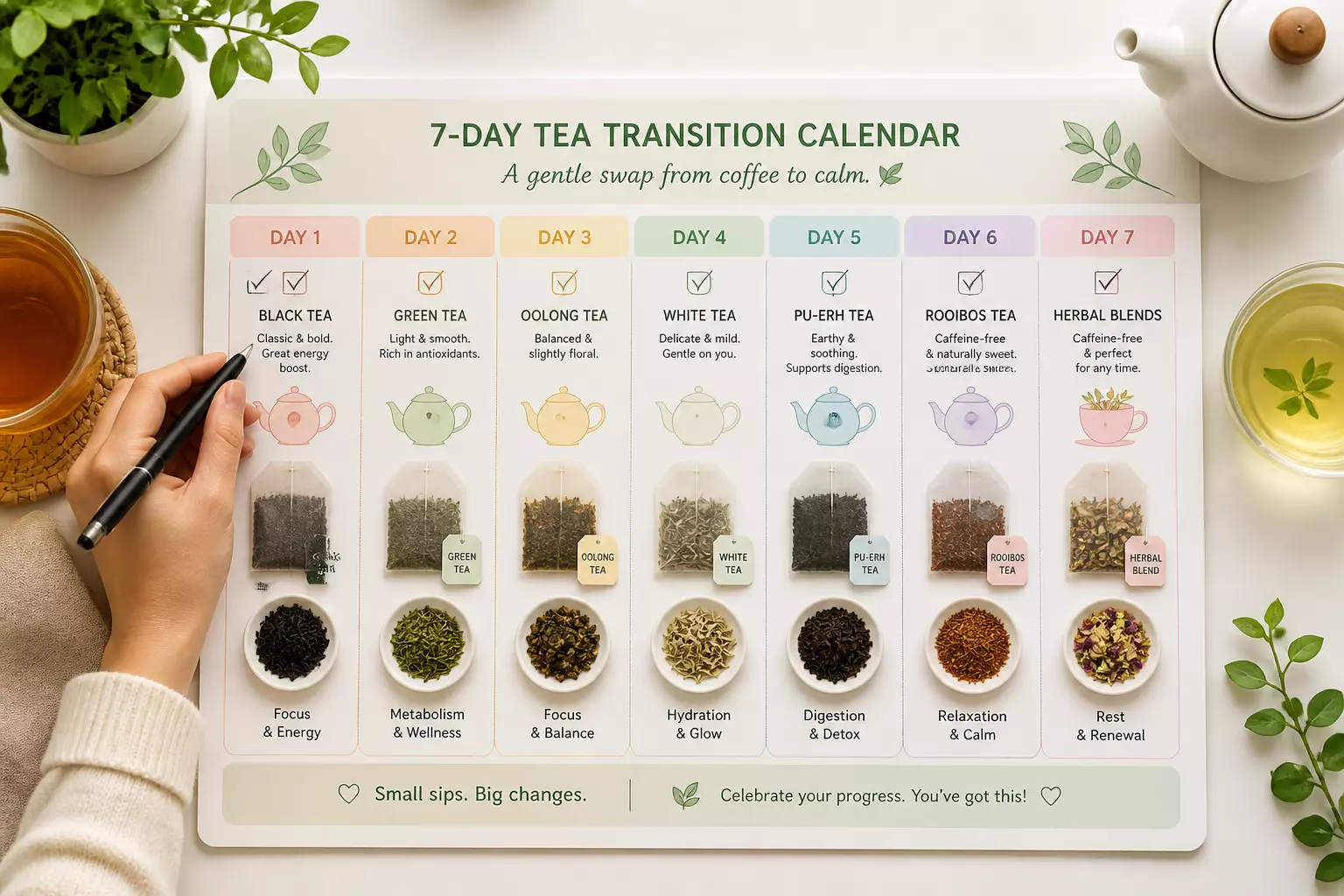
This structured approach is designed to make the transition feel natural rather than forced. The goal in week one is to replace just one coffee per day with tea — typically your second or third cup, not your first. You’re not going cold turkey. You’re building a new habit alongside an existing one.
Days 1–2: Start With Black Tea
Black tea is your bridge. With up to 70mg of caffeine per 8oz cup, it’s the closest thing to coffee in the tea world [4]. It’s bold, slightly bitter, and pairs beautifully with milk and a touch of sweetener — making it feel familiar to coffee drinkers.
Recommended approach:
- Brew black tea strong (steep for 4–5 minutes)
- Add a splash of oat milk or whole milk if you take your coffee with dairy
- Drink it in your usual coffee mug to preserve the ritual
Popular black tea varieties to try: Assam, English Breakfast, Earl Grey, Darjeeling
Days 3–4: Introduce Green Tea
By day three, your body is adjusting. Now introduce green tea for your swapped cup. Green tea has a lighter caffeine load (20–45mg) and a distinctly different flavor — grassy, vegetal, sometimes sweet — that begins to train your palate toward the tea world [3].
Brewing tip: Never pour boiling water directly onto green tea. Use water at 160–175°F (70–80°C) to avoid bitterness. Steep for 2–3 minutes maximum.
Day 5: Try Oolong Tea
Oolong sits beautifully between black and green tea — partially oxidized, with a complex flavor that can range from floral and light to rich and roasted depending on the variety. It’s a wonderful middle-ground tea for people who find green tea too light but want something less intense than black [3].
Days 6–7: Explore Herbal and Specialty Teas
By now, you’ve successfully replaced one coffee per day for nearly a week. Days 6 and 7 are about expanding your tea identity — trying something outside the traditional tea leaf entirely.
Herbal options to explore:
- 🌼 Chamomile — Naturally calming, caffeine-free, excellent for afternoon or evening
- 🌿 Rooibos — Caffeine-free, high in antioxidants, naturally sweet and earthy [1]
- 🫚 Ginger tea — Warming, digestive, energizing without caffeine
- 🍃 Peppermint — Refreshing, mentally clarifying, great for post-lunch slumps
Practical Tips to Make the Swap Stick
Knowing the plan is one thing. Making it stick in real life requires a few practical strategies.
Invest in Basic Equipment
You don’t need an expensive setup, but a few key items make a real difference:
- A good electric kettle with temperature control — This is especially important for green and white teas, which require lower temperatures
- A simple infuser or teapot — Loose leaf tea is generally higher quality and more satisfying than tea bags
- A large, beautiful mug — Sounds trivial, but drinking from a mug you love genuinely improves the experience
Timing Your Swap Strategically
Don’t replace your first coffee of the day in week one. That first-morning coffee is the most emotionally loaded and physiologically important. Instead, replace your second or third cup — the one you drink out of habit rather than genuine need.
Once you’ve successfully replaced that cup for two weeks, you can consider whether you want to tackle the morning coffee too.
Pair Your Tea With a Complementary Ritual
If you always drink your afternoon coffee while checking emails, brew tea instead during that same window. The environmental cues (the time, the location, the activity) help anchor the new behavior. You’re not fighting the habit — you’re redirecting it.
Handle Headaches Proactively
If you experience mild headaches in the first few days, this is normal and temporary. Black tea’s caffeine content is usually sufficient to prevent withdrawal headaches when replacing one cup of coffee. Stay hydrated, drink your tea at roughly the same time you’d have your coffee, and the headaches typically resolve within 2–3 days.

The Health Benefits You’ll Actually Notice
Once you’ve successfully learned how to swap one coffee a day for tea without feeling deprived, the benefits tend to become self-reinforcing. Here’s what you can realistically expect to notice:
Better Sleep Quality 😴
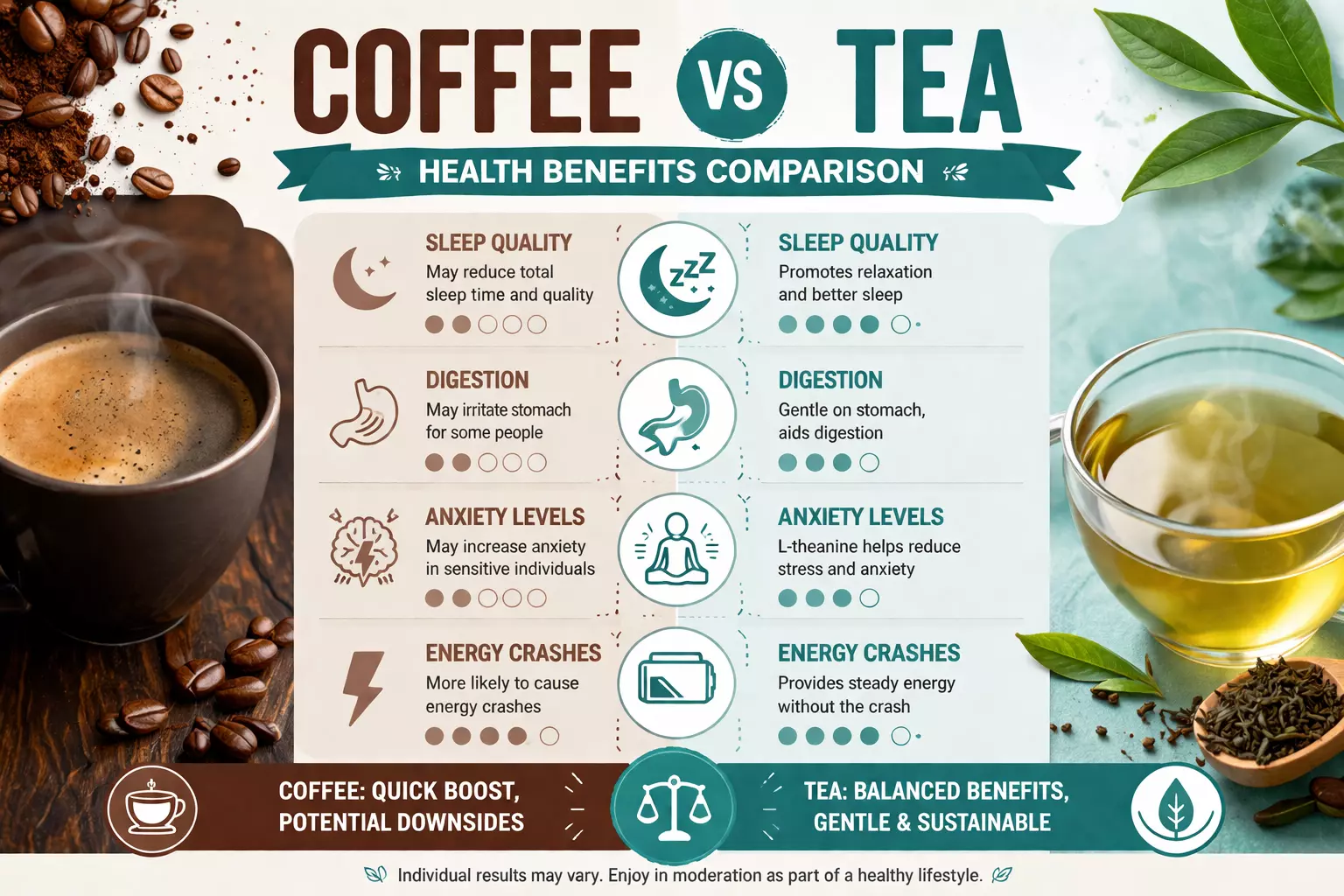
Tea’s lower caffeine content is significantly less disruptive to sleep cycles than coffee [2]. If your swapped cup is an afternoon or evening one, the improvement in sleep quality can be noticeable within the first week. Herbal options like chamomile actively promote relaxation and sleep, making them ideal evening replacements.
Reduced Anxiety and Steadier Mood
Coffee acts as a stimulant that can reduce serotonin levels over time — a mechanism that contributes to anxiety and mood instability in some people [4]. Tea, particularly due to its L-theanine content, does not carry this risk. Many people report feeling calmer and more emotionally even after just a week of reducing their coffee intake.
Gentler Digestion
The reduction in dietary acid that comes from replacing one coffee with tea can meaningfully reduce acid reflux symptoms, morning stomach discomfort, and general digestive irritation [2]. This is often one of the first physical benefits people notice.
Sustained Energy Without the Crash
The combination of moderate caffeine and L-theanine in tea produces energy that doesn’t spike and crash the way coffee’s does [4]. After a week or two, many people describe their energy as feeling more even and reliable — less dependent on the next caffeine hit.
How to Swap One Coffee a Day for Tea Without Feeling Deprived: Common Mistakes to Avoid
Even with the best plan, a few common mistakes can derail the swap or make it feel harder than it needs to be.
❌ Mistake 1: Starting With Weak or Low-Quality Tea
If your first experience of tea is a stale supermarket tea bag steeped in boiling water for 30 seconds, you’re not going to be impressed. Quality matters enormously in tea. Start with a reputable brand or a specialty tea shop, and follow proper brewing instructions.
❌ Mistake 2: Replacing Your First Coffee Immediately
As mentioned above, the morning coffee is the hardest to replace because it’s the most ritualized and the most physiologically necessary. Start with your second or third cup and work backward once the habit is established.
❌ Mistake 3: Expecting Tea to Taste Like Coffee
Tea is not coffee. It will never taste like coffee. The sooner you stop expecting it to replicate the experience and start appreciating it on its own terms, the faster you’ll genuinely enjoy it.
❌ Mistake 4: Giving Up After One Bad Cup
Tea has a learning curve. Oversteeping, wrong water temperature, and poor quality leaves all produce unpleasant results. One bad cup doesn’t mean tea isn’t for you — it means you need to adjust your technique.
❌ Mistake 5: Not Having Tea Readily Available
If you have to make a special effort to brew tea while your coffee maker is sitting right there, you’ll default to coffee every time. Keep your tea supplies as accessible as your coffee supplies — on the counter, not tucked away in a cabinet.
Building Your Long-Term Tea Habit
The goal of this guide isn’t to turn you into a tea purist who never touches coffee again. The goal is to help you reduce your coffee intake by one cup per day in a way that feels sustainable and genuinely satisfying.
Once you’ve successfully replaced one cup for 30 days, you’ll likely find that:
- Your coffee cravings have naturally reduced
- You genuinely look forward to your tea ritual
- Your body feels better in measurable ways
- You’re curious about exploring more tea varieties
At that point, you can decide whether to maintain the one-swap habit, reduce further, or simply enjoy the balance you’ve found.
Building a Tea Pantry 🫖
A well-stocked tea selection makes the habit easy to maintain:
Everyday staples:
- English Breakfast or Assam (morning black tea)
- Sencha or Dragon Well (afternoon green tea)
- Chamomile or rooibos (evening herbal)
For variety and exploration:
- Oolong (roasted or floral)
- Earl Grey (bergamot-infused black tea)
- Peppermint or ginger (digestive and energizing)
Interactive Tea Finder Tool
Use the tool below to find the best tea for your specific needs and preferences:
Find Your Perfect Tea Swap
Answer 4 quick questions and we’ll match you with the ideal tea to replace that one cup of coffee — no deprivation required.
Conclusion: One Cup at a Time Changes Everything
The most important thing to remember about how to swap one coffee a day for tea without feeling deprived is that this is not about deprivation at all. It’s about addition — adding variety, adding ritual, adding a gentler form of energy that serves your body better.
Start with just one swap. Pick your second or third coffee of the day. Replace it with a strong black tea on day one. Follow the 7-day plan. Use the tea finder tool above to discover varieties that genuinely excite you.
Within two weeks, most people find they don’t miss that extra cup of coffee — because they’ve replaced it with something they actually look forward to. The sustained energy, the better sleep, the calmer mornings — these aren’t small things. They compound into a meaningfully better daily experience.
Your actionable next steps for this week:
- ✅ Order a tea sampler pack (6–10 varieties) today
- ✅ Identify which coffee you’ll replace first (not your first cup)
- ✅ Get a temperature-controlled kettle if you don’t have one
- ✅ Use the tea finder tool above to identify your starting tea
- ✅ Commit to 7 days — just one swap per day
One cup. Seven days. That’s all it takes to start.
References
[1] Switch Coffee To Tea Effects – https://www.nationalgeographic.com/science/article/switch-coffee-to-tea-effects
[2] The Benefits Of Switching From Coffee To Tea In The Morning – https://fullmoonteacompany.com/blogs/tea-time-blog/the-benefits-of-switching-from-coffee-to-tea-in-the-morning
[3] Turning Over A New Leaf A Comprehensive Guide To Quitting Coffee And A Week Long Coffee Reduction Plan – https://www.theteaspot.com/blogs/steep-it-loose/turning-over-a-new-leaf-a-comprehensive-guide-to-quitting-coffee-and-a-week-long-coffee-reduction-plan
[4] 20 Reasons To Switch From Coffee To Tea – https://www.goodlifetea.com/blogs/news/20-reasons-to-switch-from-coffee-to-tea