
Migraine or Caffeine Withdrawal? How to Taper Off Safely
Roughly half of all people who stop caffeine abruptly will develop a throbbing head within 12 to 24 hours — and for the millions who already live with migraines, that headache can quickly spiral into something far more disabling. [1] If you’ve ever tried to quit your morning coffee only to end up flat on the couch by afternoon, you already know the frustration. The question “Migraine or Caffeine Withdrawal? How to Taper Off Safely” isn’t just academic — it’s a real clinical puzzle that affects daily life, productivity, and long-term health decisions.
Disclosure: This post contains affiliate links. As an Amazon Associate, we earn from qualifying purchases, and at no extra cost to you.
This guide breaks down the science behind both conditions, shows you how to tell them apart, and walks you through a practical, evidence-based tapering plan that minimizes pain along the way.
Key Takeaways 📌
- Withdrawal headaches begin within 12–24 hours of stopping caffeine and peak between 20–51 hours; they typically resolve within one week. [1]
- Migraine sufferers face a higher risk of severe, disabling headaches during caffeine withdrawal due to caffeine’s dual role as both a trigger and a treatment. [2]
- Gradual tapering — reducing intake by roughly 25% per week — is the safest and most effective strategy for quitting caffeine. [3]
- Hydration, consistent sleep, and OTC pain relievers are the frontline management tools for withdrawal symptoms. [1][5]
- A 2 p.m. caffeine cutoff helps protect sleep quality during the tapering process. [6]
- Interactive Tool: Caffeine Taper Calculator
Understanding the Difference: Migraine vs. Caffeine Withdrawal Headache
Before diving into how to taper off safely, it helps to understand what you’re actually dealing with. These two types of head pain share symptoms but have meaningfully different causes, durations, and treatment paths.
What Is a Caffeine Withdrawal Headache?
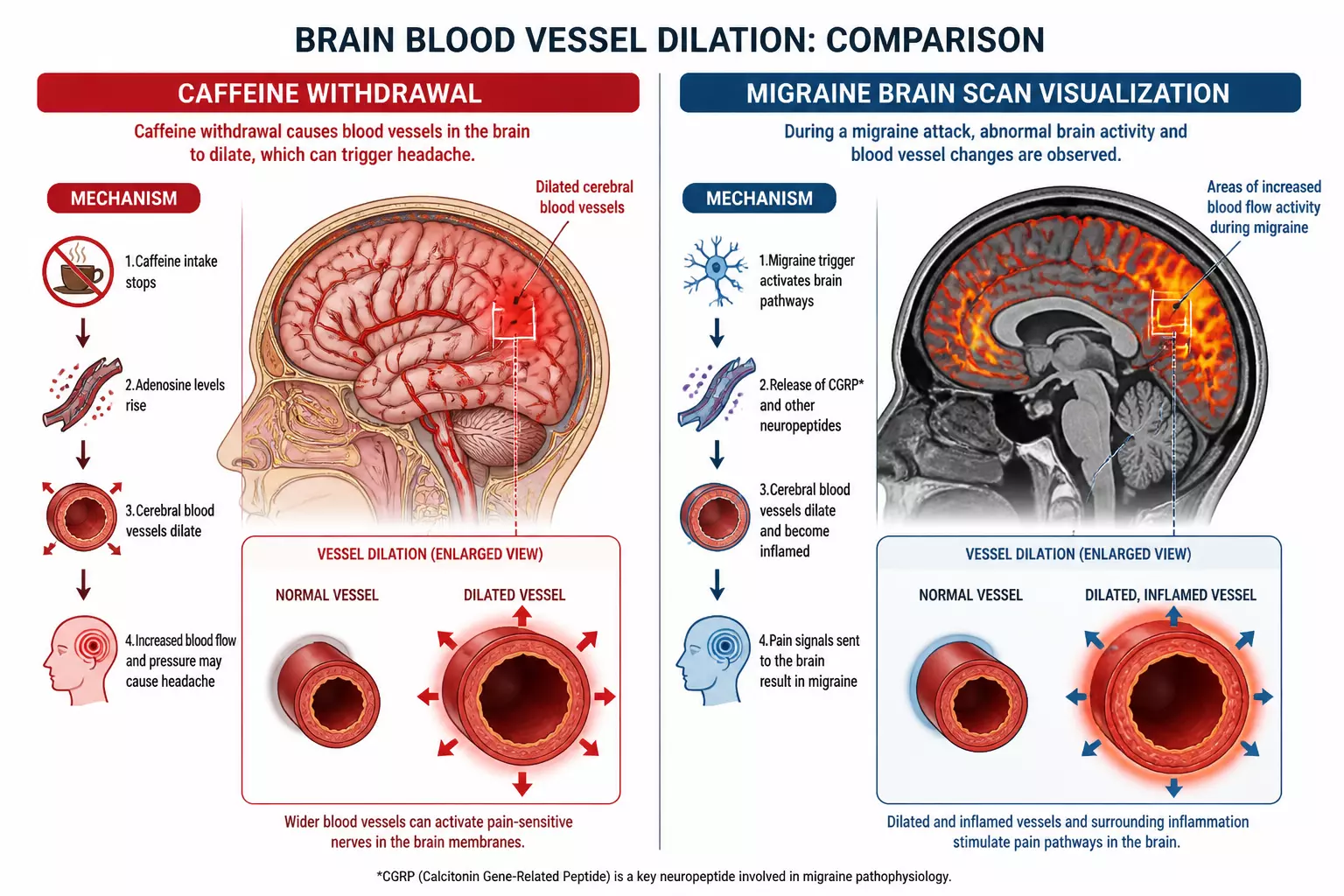
When you consume caffeine regularly, your brain adapts. Caffeine blocks adenosine receptors — the receptors that signal fatigue. Over time, your brain grows more of these receptors to compensate. When caffeine is suddenly removed, adenosine floods those receptors all at once, causing blood vessels in the brain to dilate and blood pressure to rise locally. [3] The result: a dull, diffuse, often throbbing headache.
Key characteristics of caffeine withdrawal headaches:
- Onset: 12–24 hours after last caffeine dose [1]
- Peak: 20–51 hours after cessation [1]
- Duration: Usually resolves within 2–9 days [4]
- Location: Often bilateral (both sides of the head)
- Relief: Improves with caffeine, ibuprofen, or acetaminophen [5]
What Is a Migraine?
Migraine is a neurological disorder, not simply a bad headache. It involves complex changes in brain chemistry and nerve signaling. A migraine attack typically lasts 4–72 hours and is often accompanied by nausea, vomiting, and extreme sensitivity to light and sound.
Key characteristics of a migraine:
- Onset: Can be triggered by many factors (hormones, stress, sleep changes, caffeine)
- Duration: 4–72 hours per attack [2]
- Location: Often unilateral (one side of the head), pulsating
- Associated symptoms: Nausea, photophobia, phonophobia, sometimes aura
- Relief: Requires triptans or specific migraine medications in moderate-to-severe cases
Side-by-Side Comparison 🔍
| Feature | Caffeine Withdrawal | Migraine |
|---|---|---|
| Onset | 12–24 hrs after stopping caffeine | Varies; triggered by many factors |
| Duration | 2–9 days | 4–72 hours per attack |
| Location | Both sides, diffuse | Often one side, pulsating |
| Nausea | Mild, possible | Common, sometimes severe |
| Light sensitivity | Mild | Often severe |
| Relieved by caffeine? | Yes, temporarily | Sometimes; can also trigger |
| Resolves on its own? | Yes, within ~1 week | Varies; may need medication |
💡 Pull Quote: “Caffeine can both trigger and help abort migraine attacks — making it one of the most complicated dietary factors for migraine patients to manage.” [2]
Why the Question “Migraine or Caffeine Withdrawal? How to Taper Off Safely” Matters Most for Migraine Patients
For people without a migraine history, caffeine withdrawal is uncomfortable but manageable. For those with migraine, the situation is considerably more complex.
The Caffeine-Migraine Paradox
Caffeine is a double-edged sword in migraine management:
- As a treatment: Small doses of caffeine (50–100 mg) can constrict dilated blood vessels and enhance the effectiveness of pain relievers like acetaminophen. That’s why caffeine appears in many OTC migraine medications. [1][2]
- As a trigger: Regular high caffeine intake sensitizes the brain. When levels drop — even slightly — a migraine can be triggered. This creates a cycle where people use caffeine to treat the very headaches that caffeine dependence is causing. [2]
Medication Overuse Headache (MOH): Migraine patients who use caffeine-containing medications more than 10–15 days per month are at risk of developing MOH, also called “rebound headache.” This makes the underlying migraine disorder worse over time.
Who Is Most at Risk?
People who are most vulnerable to severe withdrawal headaches include:
- ✅ Those with a diagnosed migraine disorder
- ✅ High daily caffeine consumers (400 mg or more per day)
- ✅ People who consume caffeine inconsistently (e.g., weekday-only drinkers)
- ✅ Those who are sleep-deprived or under high stress
- ✅ Individuals who have tried to quit “cold turkey” before
⚠️ Important Note: Migraine patients should ideally work with a neurologist or headache specialist before significantly changing their caffeine intake. [2]
How to Taper Off Safely: A Step-by-Step Guide
Now for the practical part. The answer to “Migraine or Caffeine Withdrawal? How to Taper Off Safely” is almost always the same: go slowly, go deliberately, and support your body throughout the process.
Step 1: Know Your Baseline
Before you cut anything, track your current caffeine intake for 3–5 days. Include:
- ☕ Coffee (drip, espresso, cold brew)
- 🍵 Tea (black, green, white)
- 🥤 Energy drinks and sodas
- 💊 OTC medications containing caffeine (e.g., Excedrin, Midol)
- 🍫 Dark chocolate (contains small amounts)
Common caffeine content reference:
| Source | Approximate Caffeine |
|---|---|
| Drip coffee (8 oz) | 95–165 mg |
| Espresso (1 shot) | 63 mg |
| Cold brew (8 oz) | 100–200 mg |
| Black tea (8 oz) | 40–70 mg |
| Green tea (8 oz) | 20–45 mg |
| Energy drink (8 oz) | 70–150 mg |
| Cola soda (12 oz) | 30–40 mg |
| Excedrin (2 tablets) | 130 mg |
Step 2: Set a Realistic Tapering Schedule
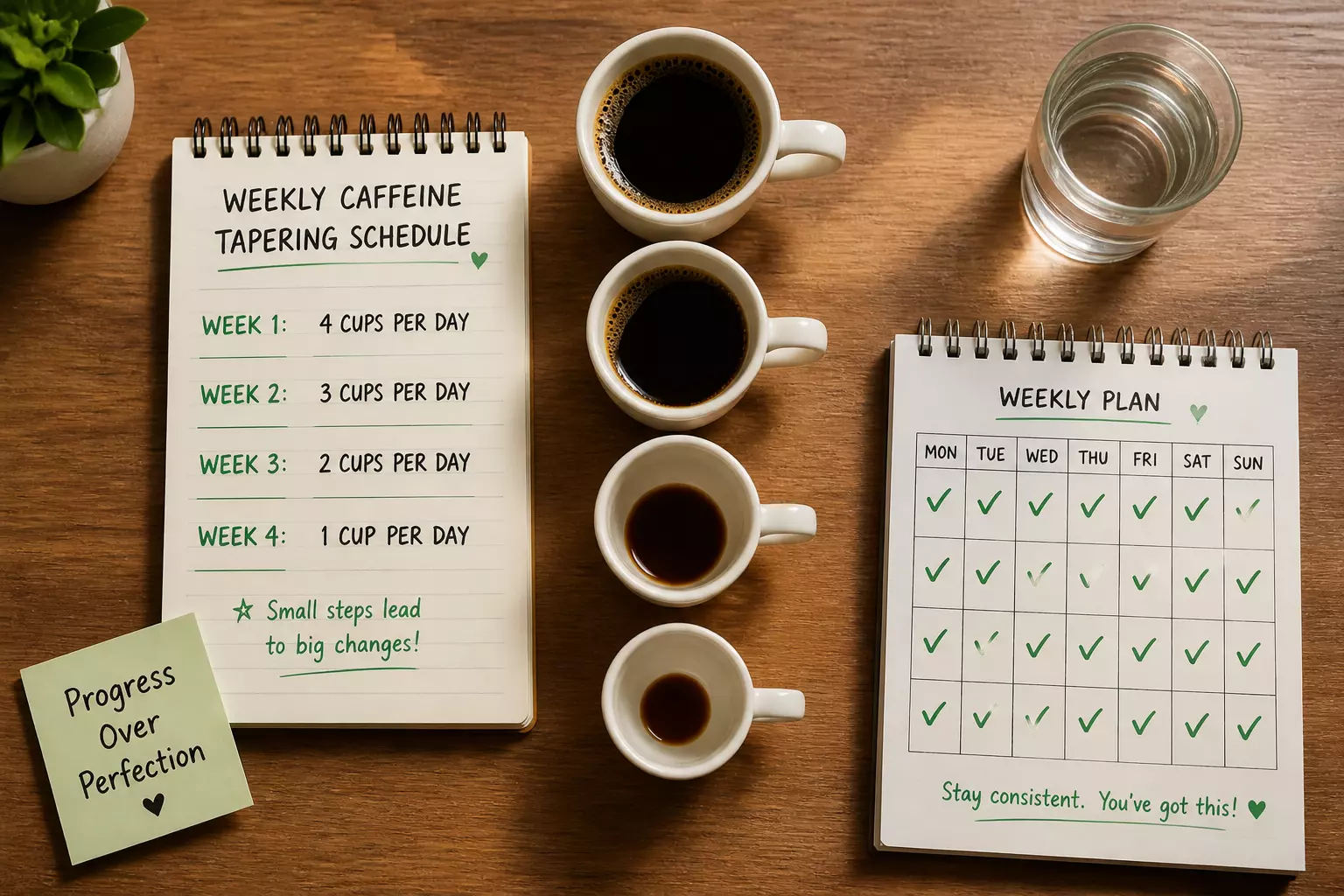
The gold standard approach is to reduce your daily caffeine intake by 25% every 1–2 weeks. [1][3] This gives your brain time to re-regulate adenosine receptors without triggering severe withdrawal symptoms.
Example 4-week taper (starting at 400 mg/day):
| Week | Daily Target | Equivalent (approx.) |
|---|---|---|
| Week 1 | 300 mg | ~2 large coffees |
| Week 2 | 225 mg | ~1.5 large coffees |
| Week 3 | 150 mg | ~1 large coffee |
| Week 4 | 75 mg | ~1 small coffee or 2 black teas |
| Week 5+ | 0 mg (or maintain low dose) | Herbal tea, decaf |
💡 Pro Tip: Mixing regular and decaf coffee is one of the easiest ways to reduce caffeine without changing your routine dramatically. Start with a 75/25 regular-to-decaf ratio and shift it each week.
Step 3: Apply the 2 p.m. Rule
One of the simplest and most effective strategies is to set a hard cutoff of 2 p.m. for all caffeine consumption. [6] Caffeine has a half-life of approximately 5–6 hours in most adults, meaning that a 200 mg coffee at 2 p.m. still leaves ~100 mg in your system at 8 p.m. Poor sleep then worsens withdrawal symptoms the next day, creating a vicious cycle.
Step 4: Support Your Body Through the Taper
Even with a gradual taper, you may experience some mild symptoms. Here’s how to manage them:
🥤 Hydration
Dehydration worsens headaches of all types. Aim for at least 8 cups (2 liters) of water per day during your taper. [5] Electrolyte-rich drinks like coconut water or diluted sports drinks can also help.
😴 Sleep Optimization
- Keep a consistent sleep and wake time — even on weekends
- Avoid screens 1–2 hours before bed [3]
- Keep your bedroom cool and dark
- Avoid alcohol, which fragments sleep and worsens withdrawal
💊 OTC Pain Relief
Ibuprofen (Advil) or acetaminophen (Tylenol) can manage breakthrough headaches during the taper. [1][5] However, use these sparingly — particularly if you have migraines, as overuse can lead to MOH.
🏃 Light Exercise
Gentle movement like walking or yoga can improve mood, reduce anxiety, and support better sleep. Avoid intense exercise during peak withdrawal days, as it can temporarily worsen headaches.
🍽️ Nutrition
Don’t skip meals. Blood sugar dips can trigger headaches independently of caffeine. Eat regular, balanced meals with protein and complex carbohydrates.
Managing Symptoms: What to Expect Week by Week
Understanding the withdrawal timeline helps you stay committed when symptoms feel discouraging.
The Withdrawal Timeline
Days 1–2 (Peak Risk Zone):
This is when symptoms are most intense if you’ve reduced significantly. Expect possible headache, fatigue, irritability, and difficulty concentrating. [1][7] With a gradual taper, these should be mild.
Days 3–4:
Most people begin to feel improvement. Headaches become less frequent. Energy levels may still be lower than normal. Some people report mild mood changes or low-level anxiety. [7]
Days 5–7:
Significant improvement for most people. Adenosine receptor levels begin to normalize. Sleep often improves noticeably during this phase.
Week 2 and Beyond:
Most withdrawal symptoms resolve entirely within one week. [1] Many people report that their baseline energy actually improves once dependence is broken — no longer needing caffeine just to feel “normal.”
💬 Pull Quote: “Caffeine withdrawal produces no life-threatening or permanent complications, though symptoms can be functionally disabling during the first 48 hours.” [1]
Common Symptoms and How to Handle Them
| Symptom | Why It Happens | What Helps |
|---|---|---|
| Headache | Blood vessel dilation from adenosine surge | Hydration, ibuprofen, cold compress [5] |
| Fatigue | Adenosine receptors now fully active | Short naps (20 min), light exercise [3] |
| Irritability | Dopamine pathway disruption | Mindfulness, social support |
| Difficulty concentrating | Reduced dopamine and norepinephrine | Break tasks into small steps, be patient |
| Nausea | GI tract sensitivity | Ginger tea, small frequent meals [7] |
| Anxiety | Nervous system recalibration | Deep breathing, reduced screen time |
| Depression/low mood | Temporary neurotransmitter shifts | Exercise, sunlight, social connection [7] |
When to See a Doctor: Red Flags You Shouldn’t Ignore

Not every headache during a caffeine taper is withdrawal. Some require medical attention. Seek care promptly if you experience:
- 🚨 “Thunderclap” headache — sudden, severe onset (worst headache of your life)
- 🚨 Headache with fever, stiff neck, or rash
- 🚨 Headache with vision changes, confusion, or weakness
- 🚨 Headache lasting more than 72 hours despite treatment
- 🚨 Vomiting that prevents you from staying hydrated
For migraine patients specifically, consult your neurologist or headache specialist before beginning a caffeine taper if:
- You use caffeine-containing medications more than 10 days per month
- You have more than 4 migraine days per month
- You are currently on preventive migraine therapy
Your doctor may want to coordinate your caffeine reduction with adjustments to your migraine treatment plan. [2]
Special Considerations: Migraine or Caffeine Withdrawal? How to Taper Off Safely When You Have Both
For people managing active migraine disease, the tapering process needs extra care and patience.
The “Caffeine Holiday” Approach
Some headache specialists recommend a supervised “caffeine holiday” — a structured period of complete caffeine elimination — as part of breaking the rebound headache cycle. This is typically done under medical supervision and may involve:
- Temporary use of prescription anti-nausea medications
- Bridge therapy with longer-acting medications to manage withdrawal
- A headache diary to track patterns before, during, and after the taper
Should Migraine Patients Keep Any Caffeine?
This is genuinely debated among headache specialists. Some evidence suggests that low, consistent caffeine intake (under 200 mg/day, consumed at the same time each day) is less harmful than irregular or high-dose use. [2] The key word is consistent — it’s the fluctuations in caffeine levels that most commonly trigger migraine attacks.
If complete elimination isn’t your goal, a reasonable middle ground is:
- One consistent daily serving (e.g., one 8 oz cup of coffee each morning)
- No caffeine after 2 p.m. [6]
- No caffeine-containing pain relievers more than 2 days per week
Tracking Your Progress 📓
Keeping a headache and caffeine diary is one of the most powerful tools available. Track:
- Daily caffeine intake (mg and timing)
- Headache occurrence, severity (1–10), and duration
- Sleep hours and quality
- Stress level
- Menstrual cycle (if applicable)
After 4–6 weeks, patterns often become clear — showing which factors most reliably trigger your headaches and whether caffeine reduction is making a measurable difference.
Lifestyle Habits That Support Long-Term Success

Tapering off caffeine is most successful when it’s part of a broader lifestyle shift rather than an isolated intervention.
Build a Morning Routine Without Caffeine as the Anchor
Many people use coffee as a psychological ritual as much as a physical stimulant. Replace the ritual, not just the drink:
- Start with a large glass of water upon waking (rehydrates after sleep)
- Try a 10-minute morning walk or stretch routine
- Use herbal teas (peppermint, ginger, rooibos) as warm beverage alternatives
- Consider matcha if you want a very gradual step-down — it contains L-theanine, which moderates caffeine’s stimulant effects
Optimize Your Natural Energy Systems
- Consistent sleep schedule: Going to bed and waking at the same time daily is one of the most powerful energy-stabilizing habits available [3]
- Strategic light exposure: Morning sunlight (10–20 minutes outdoors) helps regulate your circadian rhythm and naturally boosts alertness
- Protein-forward breakfast: Stabilizes blood sugar and reduces mid-morning energy crashes
- Movement breaks: Even a 5-minute walk every 90 minutes during work hours significantly improves sustained energy and focus
Managing Stress During the Taper
Stress is both a migraine trigger and a factor that makes withdrawal symptoms worse. During your taper period:
- Reduce major life stressors where possible (not always controllable, but worth planning around)
- Practice a brief daily mindfulness or breathing exercise
- Limit alcohol — it disrupts sleep, dehydrates, and can trigger migraines independently
Try Our Caffeine Taper Calculator
Use the interactive tool below to build your personalized caffeine tapering schedule based on your current daily intake.
Caffeine Taper Calculator
Build a personalized, evidence-based plan to reduce caffeine by ~25% per week — the safest path to avoid withdrawal headaches.
Estimate your daily caffeine
Tap items above to add them up, or type your total directly.
Choose your taper pace
Your personalized plan
For educational purposes only. Not medical advice. If you have a diagnosed migraine disorder or chronic headache condition, consult a healthcare professional before changing your caffeine intake.
Conclusion: Your Actionable Path Forward
The question of “Migraine or Caffeine Withdrawal? How to Taper Off Safely” has a clear, evidence-based answer: slow down, plan ahead, and support your body at every step.
Here’s your action plan, distilled:
- Track your baseline caffeine intake for 3–5 days before making any changes.
- Choose a gradual taper — reduce by 25% every 1–2 weeks, not all at once. [3]
- Set a 2 p.m. caffeine cutoff to protect your sleep throughout the process. [6]
- Hydrate consistently, eat regular meals, and prioritize sleep hygiene. [1][5]
- Use OTC pain relievers sparingly for breakthrough headaches, and avoid overuse. [5]
- Keep a headache diary to identify patterns and measure your progress.
- Consult a headache specialist if you have active migraine disease before making significant changes. [2]
Caffeine withdrawal is temporary. The discomfort peaks within two days and resolves within a week for most people. [1] With a thoughtful taper and the right support strategies, you can break the cycle without losing weeks of your life to debilitating headaches — and come out the other side with more stable, natural energy than you’ve had in years.
References
[1] Nbk430790 – https://www.ncbi.nlm.nih.gov/books/NBK430790/
[2] Wean Off Caffeine – https://migraine.com/blog/wean-off-caffeine
[3] Caffeine Withdrawal – https://recoverycentersofamerica.com/blogs/caffeine-withdrawal/
[4] Caffeine Withdrawal Symptoms Timeline – https://visaliarecoverycenter.com/caffeine-withdrawal-symptoms-timeline/
[5] How To Manage Caffeine Withdrawal – https://www.baptisthealth.com/blog/health-and-wellness/how-to-manage-caffeine-withdrawal
[6] How To Quit Caffeine – https://health.clevelandclinic.org/how-to-quit-caffeine
[7] How To Quit Caffeine Without The Headache – https://www.henryford.com/blog/2024/09/how-to-quit-caffeine-without-the-headache