Why Does Coffee Make Me Anxious but Tea Doesn’t? (The L-Theanine Effect)
Roughly 1 in 3 regular coffee drinkers reports feeling anxious, jittery, or on-edge after their morning cup — yet the same people can drink two or three cups of tea without a single racing heartbeat. That gap is not imaginary, and it is not just about willpower or tolerance. The answer sits inside a tiny amino acid most people have never heard of: L-theanine.
Disclosure: This post contains affiliate links. As an Amazon Associate, we earn from qualifying purchases, and at no extra cost to you.
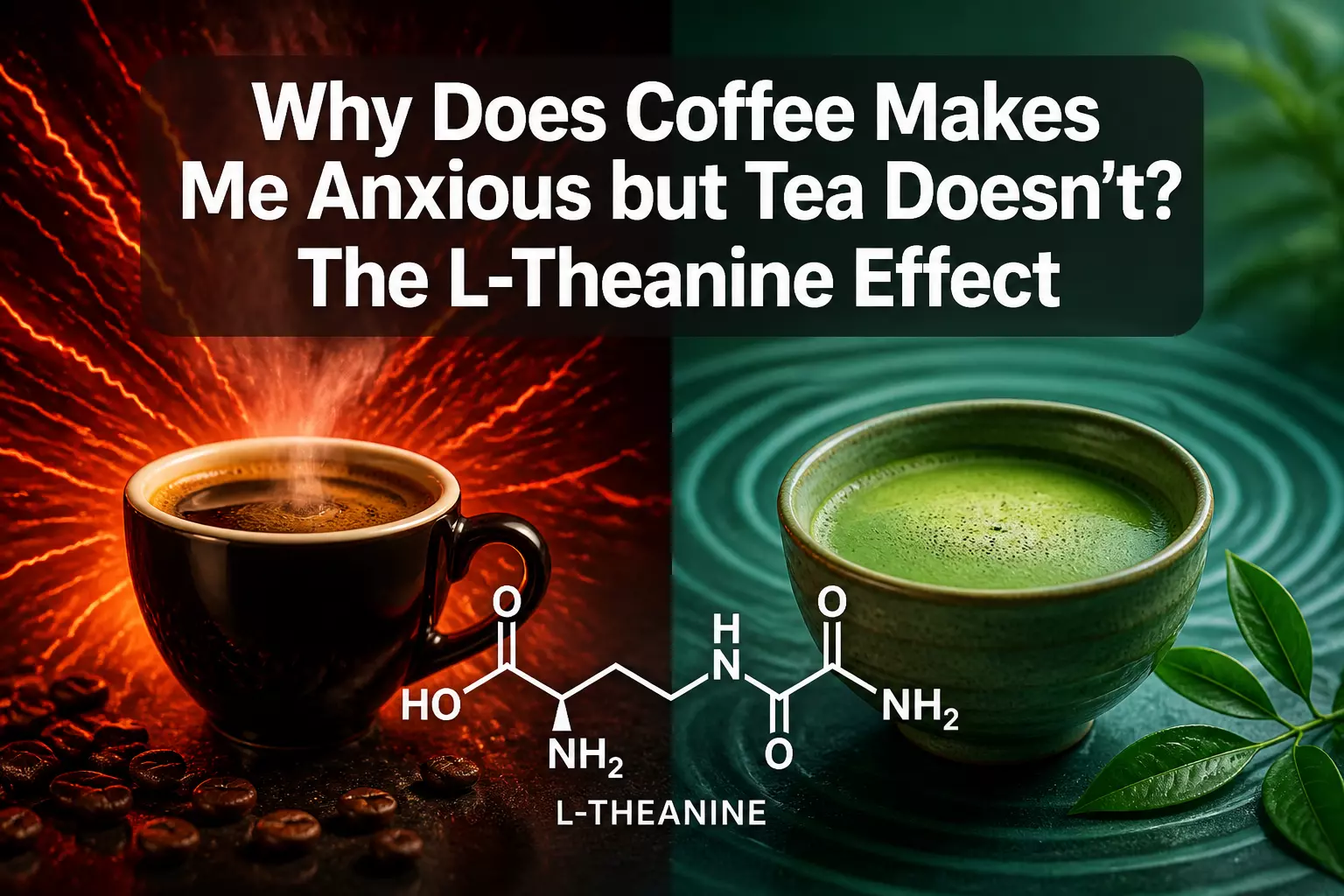
Understanding why does coffee make me anxious but tea doesn’t? (the L-theanine effect) is not just an interesting biology lesson. It is practical knowledge that can change how you choose your daily drinks, manage your energy, and protect your mental health. Let’s break it all down.
Key Takeaways 📌
- ☕ Coffee contains 2–3× more caffeine than tea, which alone accounts for much of the anxiety difference.
- 🍵 L-theanine, an amino acid found almost exclusively in tea, actively counters caffeine’s stimulating and anxiety-producing effects.
- 🧠 L-theanine works by increasing GABA and blocking glutamate, calming the nervous system without causing drowsiness.
- 🧬 Your genetics matter — slow caffeine metabolizers are far more prone to coffee-induced anxiety than fast metabolizers.
- 💊 While L-theanine supplements exist, the evidence for adding them to coffee is still limited; the safest approach is to switch to tea or reduce coffee intake.
- Interactive Tool: Find Your Caffeine-Anxiety Risk Level
The Core Problem: Why Does Coffee Make Me Anxious but Tea Doesn’t?
Before we get to L-theanine, we need to understand what caffeine actually does inside your body — because that is where the anxiety story starts.
How Caffeine Triggers Anxiety
Caffeine works by blocking adenosine receptors in the brain. Adenosine is the chemical that makes you feel sleepy. When caffeine blocks it, you feel alert and awake. But caffeine also triggers your adrenal glands to release adrenaline (epinephrine) — the same hormone that fires up your “fight or flight” response.
The result? Your heart beats faster, your blood pressure rises, your muscles tense up, and your mind races. For many people, especially those who are sensitive to caffeine, this feels indistinguishable from anxiety.
💬 “Caffeine essentially mimics a stress response in the body. For sensitive individuals, that is not a pleasant alertness — it is a physiological alarm bell.”
The Caffeine Gap Between Coffee and Tea
Here is where the numbers matter:
| Beverage | Caffeine per Serving (approx.) |
|---|---|
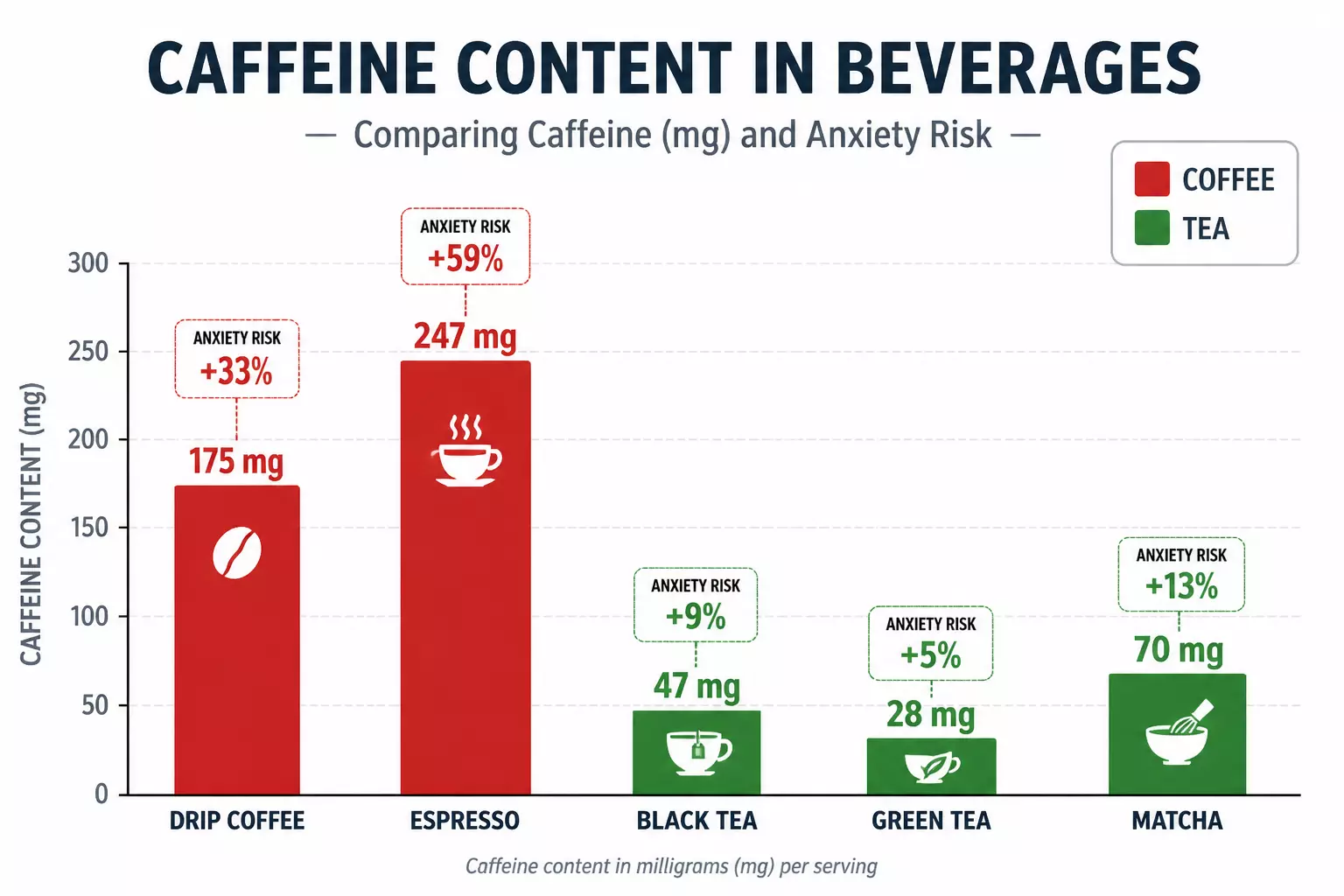
| Drip Coffee | 135–175 mg |
| Espresso (double) | 200–247 mg |
| Black Tea | 40–70 mg |
| Green Tea | 20–45 mg |
| Matcha | 60–80 mg |
Coffee contains 2–3 times more caffeine than most teas [1]. That difference alone is significant. A person who drinks a double espresso is hitting their nervous system with up to 247 mg of caffeine in one shot. A cup of green tea delivers roughly 30 mg.
So part of the answer to why does coffee make me anxious but tea doesn’t? is simply: less caffeine, less stimulation, less anxiety. But that is only half the story.
The L-Theanine Effect: What It Is and How It Works
L-theanine is a naturally occurring amino acid found almost uniquely in the Camellia sinensis plant — the same plant used to make green tea, black tea, white tea, and oolong [2]. It is not found in coffee, which is why this comparison matters so much.
What L-Theanine Does in Your Brain 🧠
L-theanine has a fascinating dual action:
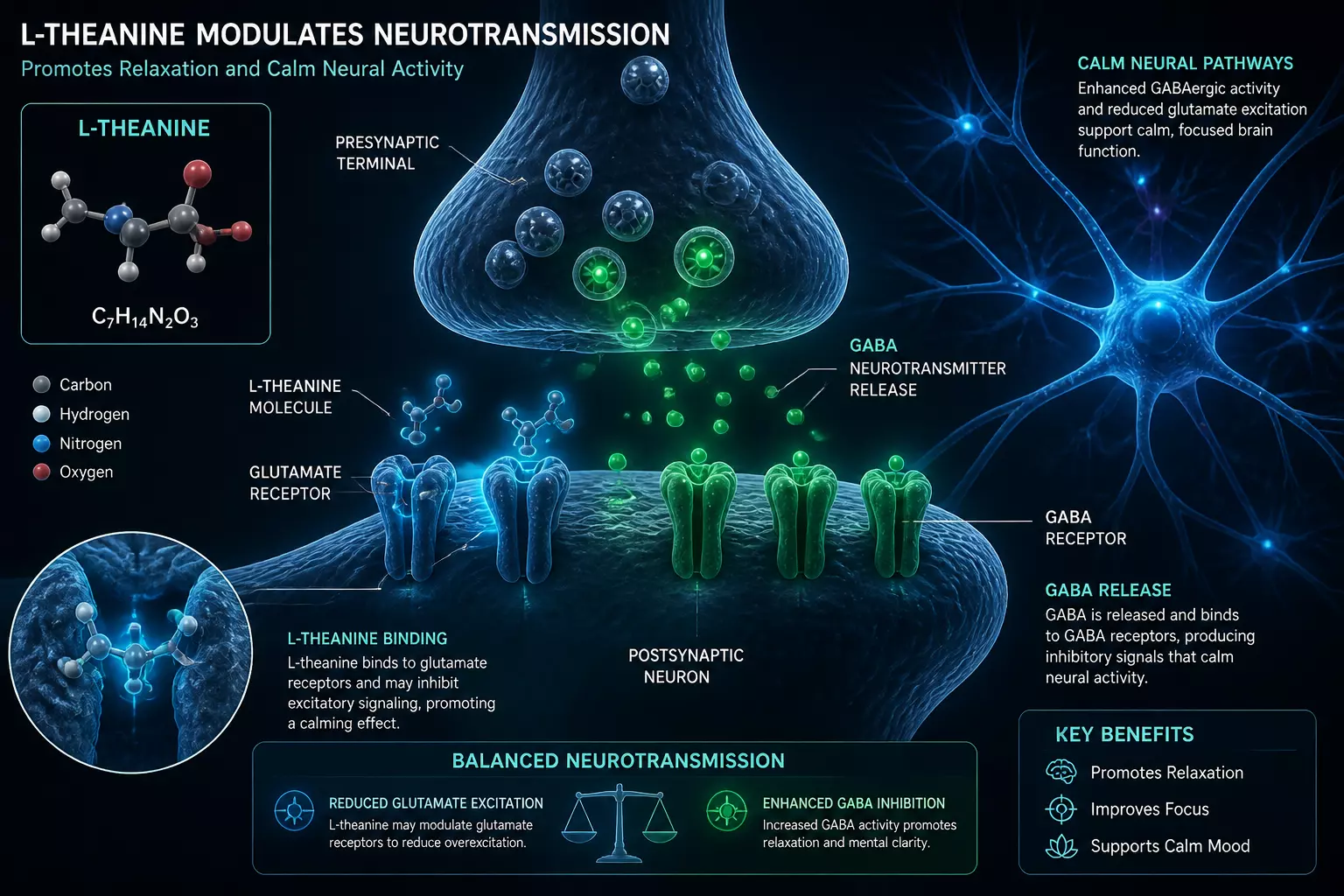
- It increases GABA release. GABA (gamma-aminobutyric acid) is your brain’s primary “calm down” neurotransmitter. More GABA means less neural excitability, less anxiety, and a quieter mind [6].
- It inhibits glutamate formation. Glutamate is an excitatory neurotransmitter — it ramps up neural activity. L-theanine blocks the glutamine transporter that feeds glutamate production, effectively putting a brake on over-stimulation [6].
- It promotes alpha brain waves. Alpha waves are associated with a state of relaxed alertness — the kind of calm focus you feel during meditation. L-theanine encourages this state without causing sedation.
Think of it this way: caffeine presses the accelerator, and L-theanine modulates the brake. Together, they create a smoother, more controlled ride.
Does L-Theanine Actually Reduce Anxiety? The Research
The evidence is genuinely promising:
- A 200 mg dose of L-theanine was shown to reduce acute stress responses, including subjective stress perception, heart rate, and salivary immunoglobulin A levels in response to mental arithmetic tasks [2].
- A 2019 systematic review found that L-theanine at 200–400 mg daily reduced stress and anxiety in people under acute stress [6].
- A meta-analysis concluded that theanine plus caffeine — and theanine alone — could benefit cognitive and mood outcomes, though researchers noted that more studies using tea beverages at tea-equivalent doses are still needed [3].
Importantly, L-theanine appears to be safe even at high doses. Studies have reported no significant adverse effects at doses of 450–900 mg in patients with generalized anxiety disorder, and 400 mg daily for six weeks in children with ADHD [5].
Why Does Coffee Make Me Anxious but Tea Doesn’t? The Caffeine-to-Theanine Ratio
Here is the key insight that ties everything together: it is not just about how much caffeine you consume — it is about the ratio of caffeine to L-theanine.
The Natural Ratio in Tea
In a typical cup of green tea, you get approximately:
- 30–40 mg of caffeine
- 20–30 mg of L-theanine
That ratio — roughly 1:1 to 2:1 (caffeine to theanine) — appears to be a sweet spot. The caffeine provides alertness and focus. The L-theanine smooths out the edges, reducing jitteriness and anxiety without eliminating the mental boost.
In coffee, you get:
- 135–247 mg of caffeine
- 0 mg of L-theanine
No buffer. No brake. Just full acceleration.
What Happens When You Combine Them?
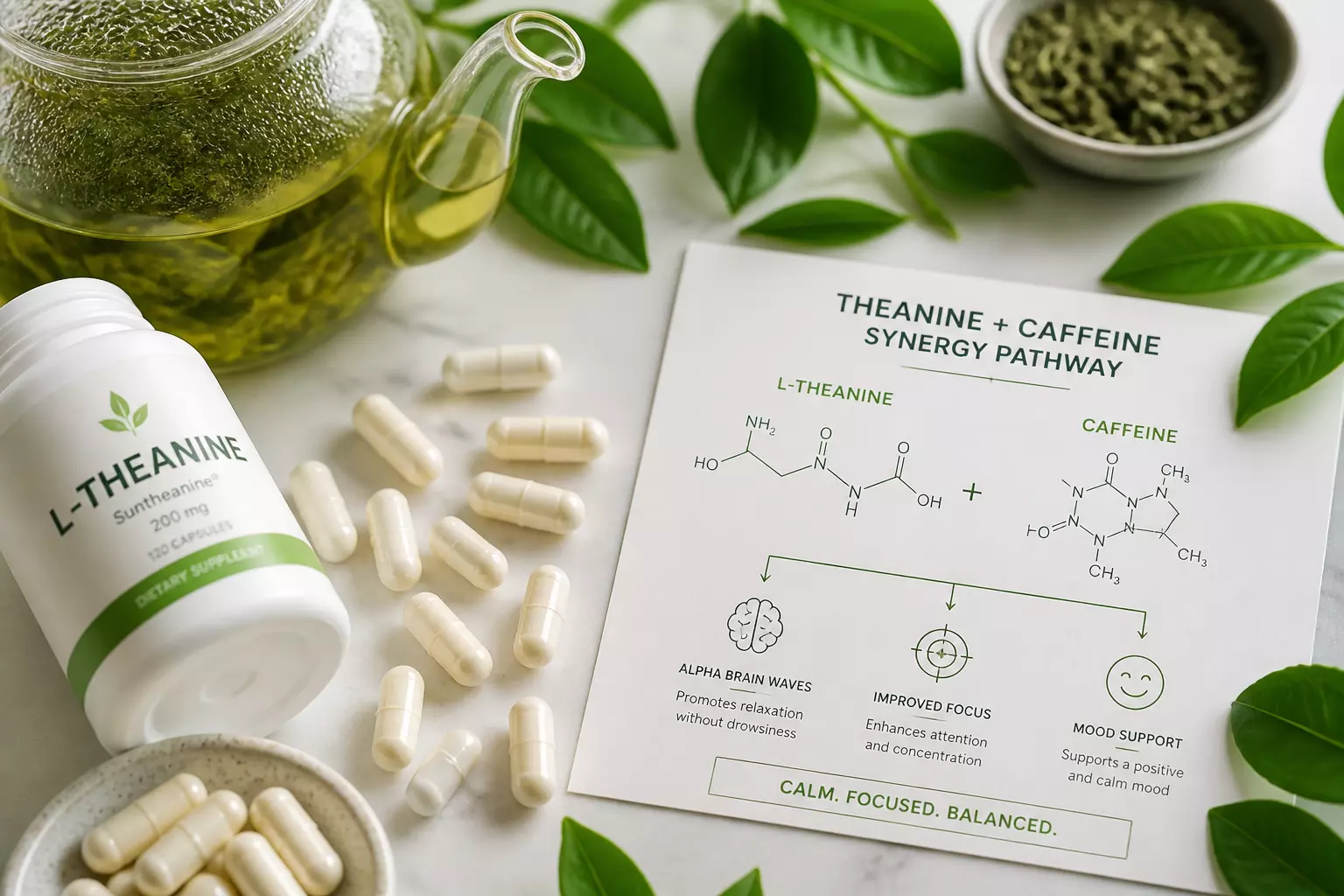
Research shows that when L-theanine is combined with caffeine at tea-equivalent levels, it eliminates caffeine’s vasoconstrictive effects [2]. Other studies support the idea that the combination improves selective attention and reduces cognitive fatigue, particularly in sleep-deprived individuals [5].
A meta-analysis confirmed that the theanine-caffeine combination produces measurable benefits for cognitive performance and mood [3]. The synergy appears real — but researchers caution that most studies use isolated supplements rather than actual tea beverages, so the real-world translation needs more investigation.
💬 “The L-theanine effect is not about eliminating caffeine’s benefits — it is about refining them. You get the focus without the frantic edge.”
Your Genetics: Why Some People Are More Sensitive Than Others
If you have ever noticed that your friend can drink three espressos and feel fine while you feel anxious after one cup, genetics are likely the reason.
Fast vs. Slow Caffeine Metabolizers
The CYP1A2 gene controls how quickly your liver breaks down caffeine. People with a “fast” variant of this gene process caffeine efficiently. People with the “slow” variant metabolize caffeine much more slowly, allowing it to accumulate in their system over time [1].
Here is what that looks like in practice:
| Metabolizer Type | Caffeine Half-Life | Risk of Anxiety |
|---|---|---|
| Fast metabolizer | ~3 hours | Lower — caffeine clears quickly |
| Slow metabolizer | ~6–8+ hours | Higher — caffeine builds up |
A fast metabolizer can drink 2–3 cups of coffee over six hours with minimal buildup [1]. A slow metabolizer drinking the same amount may still have significant caffeine in their system by bedtime — contributing to anxiety, poor sleep, and next-day fatigue.
Other Factors That Affect Caffeine Sensitivity
Beyond genetics, these factors can amplify coffee-induced anxiety:
- 🧘 Baseline anxiety levels — people with existing anxiety disorders are more sensitive to caffeine’s stimulant effects
- 💊 Medications — some antidepressants and antibiotics slow caffeine metabolism
- 😴 Sleep deprivation — being tired makes you more sensitive to stimulants
- 🍽️ Empty stomach — caffeine absorbs faster without food, intensifying effects
- 🔄 Tolerance — regular coffee drinkers develop some tolerance over time
Does Population-Level Data Support This?
Yes — with nuance. Research shows that consuming 1–3 cups of coffee daily does not typically generate anxiety disorders in the general population [1]. The key phrase is “general population.” For individuals with slow metabolism, high baseline anxiety, or genetic sensitivity, even moderate coffee consumption can trigger significant anxiety symptoms.

Practical Strategies: What You Can Actually Do About It
Understanding the science is useful. Knowing what to do with it is better. Here are actionable steps based on the evidence available in 2026.
1. Switch to Tea (or Mix Your Drinks)
The simplest solution is also the most evidence-backed. Replacing one or two daily coffees with green or black tea gives you:
- Significantly less caffeine
- Natural L-theanine
- A better caffeine-to-theanine ratio
Best teas for calm focus:
- 🍵 Green tea — lowest caffeine, high theanine, mild flavor
- 🍵 Matcha — higher caffeine than green tea but also higher theanine; smooth energy
- 🍵 Black tea — moderate caffeine, moderate theanine; closest to coffee in strength
- 🍵 White tea — very low caffeine, gentle and delicate
2. Reduce Your Coffee Dose
If you love coffee and do not want to give it up, try:
- Ordering a single shot instead of a double
- Switching from drip coffee to cold brew (which has less caffeine per ounce)
- Drinking coffee with food to slow absorption
- Stopping coffee by early afternoon to prevent accumulation
3. What About L-Theanine Supplements Added to Coffee?
This is a popular idea — and the marketing around it is aggressive. But the honest answer is: the evidence is not yet strong enough to recommend it [1]. No studies have definitively proven that adding L-theanine supplements to coffee replicates the natural balance found in tea, and the implications of combining high-dose isolated theanine with high-dose coffee caffeine have not been fully explored.
That said, L-theanine supplements are generally considered safe [5], and anecdotally many people report positive results. If you want to experiment, a dose of 100–200 mg of L-theanine paired with your coffee is within the range studied in research — just do not expect guaranteed results, and consult a healthcare provider if you have existing anxiety or take medications.
4. Know Your Metabolism Type
If you consistently feel anxious after coffee, consider:
- Tracking your symptoms in a journal to identify patterns
- Speaking with a doctor about caffeine sensitivity
- Exploring genetic testing (services that analyze the CYP1A2 gene are increasingly accessible in 2026)
5. Timing and Lifestyle Adjustments
- ⏰ Delay your first coffee by 90 minutes after waking — let your natural cortisol peak pass first
- 🥗 Never drink coffee on an empty stomach if you are anxiety-prone
- 💧 Stay hydrated — dehydration amplifies caffeine’s effects
- 😴 Prioritize sleep — fatigue dramatically increases caffeine sensitivity
The Interactive Tool: Find Your Caffeine-Anxiety Risk Level
Below is an interactive tool to help you assess your personal caffeine-anxiety risk and get a personalized recommendation.
Find Your Caffeine-Anxiety Risk Level
Answer 7 quick questions to discover your personalized risk profile and get evidence-based recommendations.
Common Myths About Coffee, Tea, and Anxiety
Let's clear up a few things that often come up in this conversation.
Myth 1: "Tea Has No Caffeine"
False. All traditional teas made from Camellia sinensis contain caffeine. Green tea, black tea, white tea, and oolong all have caffeine — just significantly less than coffee. Herbal teas (chamomile, peppermint, rooibos) are naturally caffeine-free because they are not made from the same plant.
Myth 2: "Just Add L-Theanine Supplements to Your Coffee"
Partially true, but oversimplified. While L-theanine supplements are safe and may help, there is currently insufficient research to recommend this as a proven anxiety fix [1]. The natural ratio in tea — where theanine and caffeine coexist at lower total doses — may not be replicated simply by adding a supplement to a high-caffeine coffee.
Myth 3: "Coffee Causes Anxiety Disorders"
Misleading. For the general population, moderate coffee consumption (1–3 cups daily) does not typically cause anxiety disorders [1]. However, for people who already have anxiety sensitivity or slow caffeine metabolism, coffee can trigger or worsen anxiety symptoms significantly.
Myth 4: "Decaf Coffee Is Completely Safe for Anxious People"
Mostly true, but not entirely. Decaf still contains small amounts of caffeine (typically 5–15 mg per cup). For most people this is negligible. For highly sensitive individuals, even this small amount can be noticeable.
Conclusion: Actionable Next Steps
The question of why does coffee make me anxious but tea doesn't? (the L-theanine effect) has a clear, evidence-backed answer — and it is not just in your head.
Two main forces are at work:
- Caffeine load — coffee delivers 2–3 times more caffeine than tea, triggering stronger fight-or-flight responses [1].
- L-theanine — tea's unique amino acid actively calms the nervous system by boosting GABA and blocking glutamate, creating a smoother, less anxious energy experience [6].
Add in the reality that genetics play a huge role — slow caffeine metabolizers are far more vulnerable to coffee-induced anxiety than fast ones [1] — and you have a complete picture.
Your Action Plan for 2026 🎯
- ✅ Assess your sensitivity using the quiz above
- ✅ Switch at least one daily coffee to green tea or matcha
- ✅ Track your symptoms for two weeks after changing your drink
- ✅ Eat before caffeinating to slow absorption
- ✅ Cut off all caffeine by 1–2 pm if you are anxiety-prone
- ✅ Talk to your doctor if anxiety is significantly affecting your quality of life
You do not have to choose between energy and calm. With the right knowledge — and the right drink — you can have both.
References
[1] Coffee Caffeine Anxiety - https://www.womenshealthmag.com/health/a64277082/coffee-caffeine-anxiety/
[2] Pmc4480845 - https://pmc.ncbi.nlm.nih.gov/articles/PMC4480845/
[3] academic.oup - https://academic.oup.com/nutritionreviews/article/83/10/1873/8123998
[4] Why Does Coffee Cause Anxiety While Tea Does Not - https://spacetimedrinks.com/blogs/spacenews/why-does-coffee-cause-anxiety-while-tea-does-not
[5] 8524c6d66f95fc118250fd39d78da711 - https://www.cambridge.org/core/journals/british-journal-of-nutrition/article/highdose-ltheaninecaffeine-combination-improves-neurobehavioural-and-neurophysiological-measures-of-selective-attention-in-acutely-sleepdeprived-young-adults-a-doubleblind-placebocontrolled-crossover-study/8524C6D66F95FC118250FD39D78DA711
[6] Pmc12609247 - https://pmc.ncbi.nlm.nih.gov/articles/PMC12609247/