How to Buy Great Coffee on a Budget (Without Tasting Like Dirt)
The average American spends over $1,000 a year on coffee — yet most people still complain their home brew tastes flat, bitter, or like wet soil. The dirty secret? The problem almost never comes down to how much you spend. It comes down to what you buy and how you use it.
Disclosure: This post contains affiliate links. As an Amazon Associate, we earn from qualifying purchases, and at no extra cost to you.

Learning how to buy great coffee on a budget (without tasting like dirt) is genuinely one of the most rewarding kitchen skills you can develop in 2026. With a few smart swaps — some costing less than a single café latte — you can consistently brew coffee that rivals your favorite specialty shop. No barista certification required.
Key Takeaways ☕
- Whole beans beat pre-ground every time — buy them fresh and grind at home for dramatically better flavor.
- Check roast dates, not just expiry dates — freshness is the single biggest quality factor on a budget.
- A French press or V60 costs under £15 and produces coffee far superior to most pod machines.
- Dirty equipment is a hidden flavor killer — descale and clean your brewer regularly.
- Arabica over Robusta, light-to-medium roast over dark — these two rules alone will transform your cup.
- Interactive Tool: Coffee Budget Calculator
Why Most Budget Coffee Tastes Terrible (And How to Fix It)
Before diving into the how-to, let’s diagnose the problem. Most budget coffee tastes bad for one or more of these reasons:
- 🫘 Stale beans — bought weeks or months after roasting
- 🏭 Wrong bean type — Robusta-heavy blends are harsh and earthy
- 🔧 Dirty equipment — limescale and coffee residue ruin flavor [3]
- 📦 Pre-ground coffee — loses freshness within days of grinding
- 🌡️ Mismatched brewing method — the wrong origin for the wrong brew style [5]
The good news: every single one of these is fixable without spending a fortune. Let’s break it down step by step.
Step 1: Choose the Right Beans (This Is 80% of the Battle)
Always Buy Whole Beans
This is non-negotiable. Pre-ground coffee begins losing its volatile aromatic compounds within 15–30 minutes of grinding. By the time a pre-ground bag reaches your kitchen, it has already lost a significant portion of its flavor potential. [2]
When you buy whole beans and grind just before brewing — even with a basic £10–15 burr grinder — the difference is remarkable. You’re tasting coffee the way it was meant to taste.
💬 “Whole beans are the single easiest upgrade you can make to your home coffee routine — and it costs the same or less than pre-ground.”
Pick Arabica Over Robusta
Not all coffee beans are created equal. There are two main commercial species:
| Bean Type | Flavor Profile | Caffeine | Price |
|---|---|---|---|
| Arabica | Smooth, fruity, nuanced | Lower | Slightly higher |
| Robusta | Harsh, earthy, bitter | Higher | Lower |
Most budget supermarket blends pad their bags with Robusta to cut costs. This is a primary reason cheap coffee tastes like dirt. Look for bags that specifically say “100% Arabica” on the label. [2]
Go Light or Medium Roast
Dark roasts are popular because they mask low-quality beans behind a smoky, burnt flavor. But they also go stale faster and taste more bitter. Light and medium roasts preserve the natural flavors of the bean, resist staleness better, and are generally more pleasant to drink without added sugar or cream. [2]
If you’re used to dark roast, try a medium roast first — it’s a gentler transition that still delivers body and richness.
Step 2: Master the Freshness Check at the Supermarket
Read the Roast Date, Not Just the Expiry Date
Here’s a trick most shoppers don’t know: coffee bags typically have a shelf life of 12–24 months from roasting. That means a bag with an expiry date two years away could have been roasted very recently — or it could have been sitting in a warehouse for 18 months already. [2]
Here’s the simple math:
- Find the “best before” date on the bag
- Subtract 12–24 months (depending on the brand’s stated shelf life)
- That gives you the approximate roast date
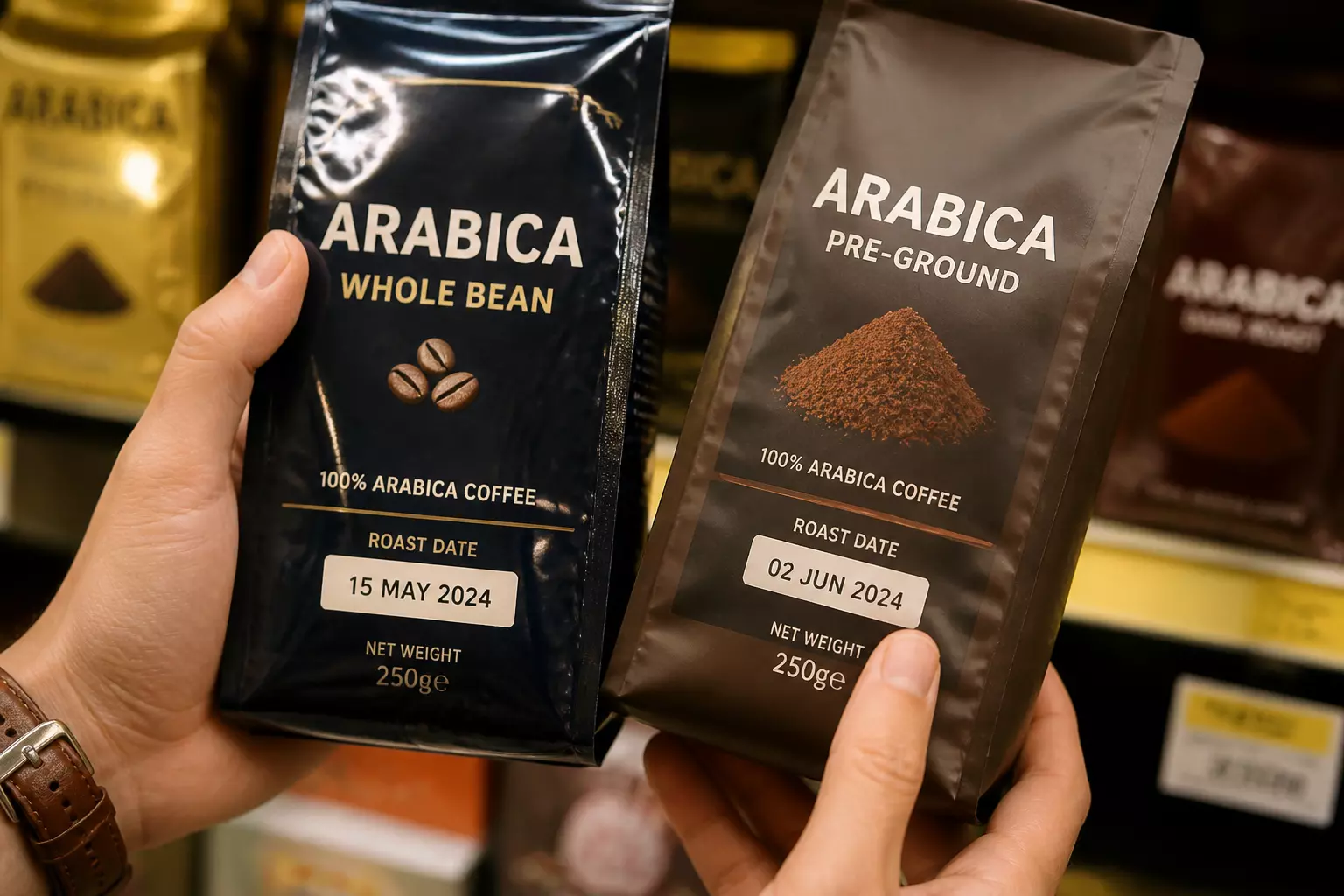
If the roast date (or “roasted on” date, if printed) is more than 6–8 weeks ago, consider a fresher option. Many specialty and supermarket bags now print the roast date directly — prioritize these. [2]
Look for One-Way Valve Bags
Quality coffee bags have a small one-way degassing valve — a tiny circular disc on the front or back. This allows CO₂ (released by fresh beans) to escape without letting oxygen in. Its presence is a strong signal that the roaster cares about freshness.
Check for Country of Origin
Single-origin coffees (from one country or region) are often more transparent about quality. Ethiopian beans tend toward fruity and floral notes; Colombian beans offer balance and mild sweetness; Brazilian beans are nutty and chocolatey. [6] Knowing origin helps you predict flavor — and match beans to your brewing method. [5]
Step 3: Pick the Right Budget Brewing Method
How to Buy Great Coffee on a Budget (Without Tasting Like Dirt) — Equipment Edition
You do not need a £200 espresso machine to make excellent coffee. Here are the three best budget brewing methods, ranked by value:
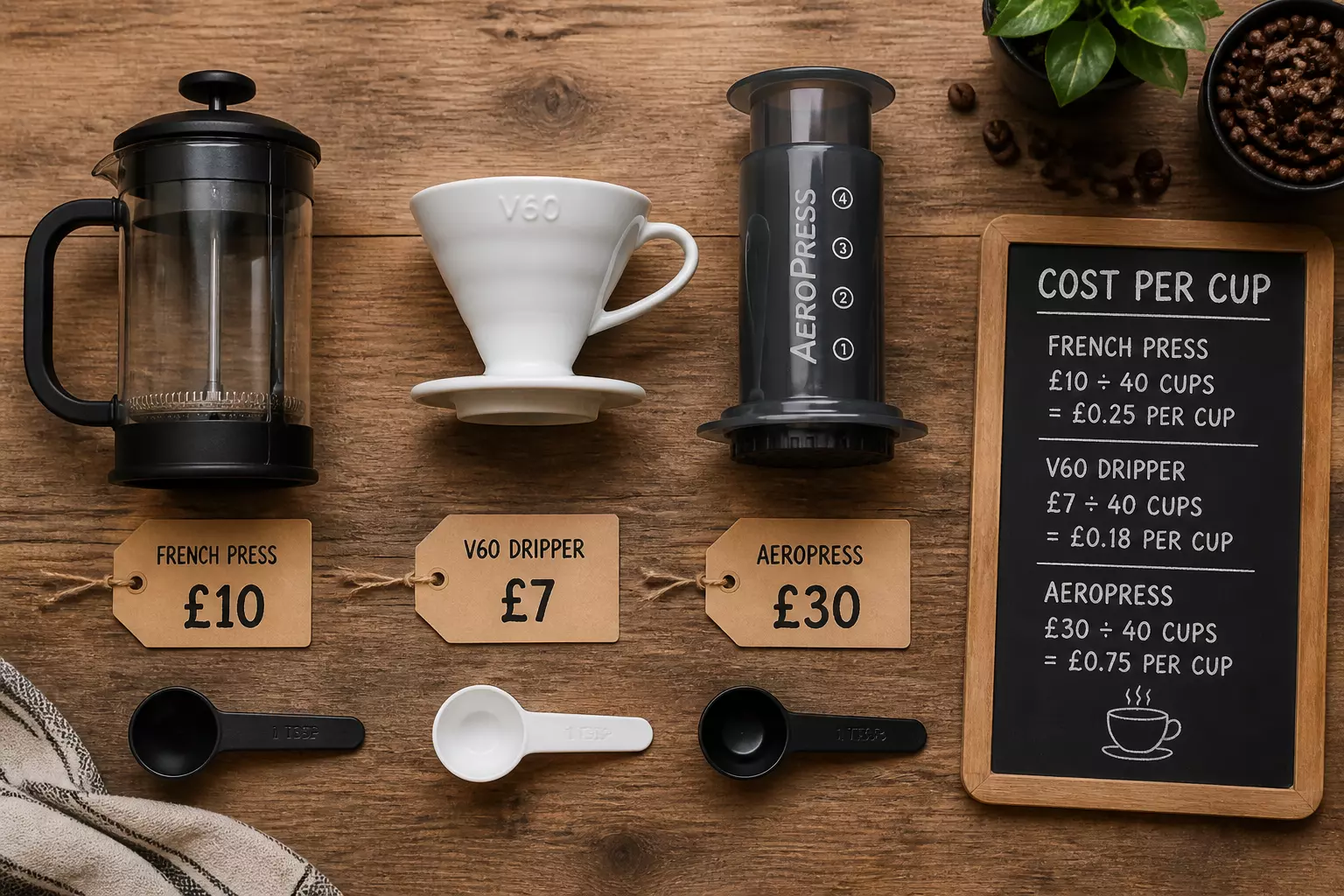
🥇 French Press — Best All-Rounder (£10–15)
The French press is arguably the most cost-effective premium brewing method available. You can find quality models for £10–15, and basic versions from budget retailers for even less. [1]
How it works:
- Add coarsely ground coffee (1 tbsp per 100ml water)
- Pour boiling water (let it cool 30 seconds off the boil)
- Steep for 4 minutes
- Press slowly and pour
Pros: Full-bodied flavor, no filters needed, durable, easy to clean
Cons: Slightly muddy texture (normal), requires coarse grind
🥈 V60 Pour-Over — Best Clarity (£5–8)
The V60 dripper costs just £5–8, and paper filters are available in packs of 100–200 for just a few pence each. [1] This method produces a cleaner, brighter cup than French press, with more nuanced flavor clarity.
How it works:
- Place filter in dripper over your mug
- Rinse filter with hot water (discard rinse water)
- Add medium-fine ground coffee
- Pour water in slow, circular motions over 3–4 minutes
Pros: Clean taste, great extraction control, portable
Cons: Slightly more technique required, ongoing filter cost
🥉 AeroPress — Best for Experimentation (£25–35)
A step up in price but incredibly versatile — the AeroPress can mimic espresso-style concentrate or produce a clean filter-style brew. It’s durable, portable, and beloved by coffee enthusiasts worldwide.
Cost Comparison: Budget Brewing vs. Café Spending
| Method | Equipment Cost | Cost Per Cup | Annual Cost (1 cup/day) |
|---|---|---|---|
| French Press | £12 | ~£0.20–0.40 | ~£90–150 |
| V60 Pour-Over | £7 | ~£0.25–0.45 | ~£100–165 |
| Café latte | £0 | ~£3.50–5.00 | ~£1,275–1,825 |
| Pod machine | £50–150 | ~£0.35–0.70 | ~£130–260 |
The savings speak for themselves. 💰
Step 4: Stop Ignoring Your Equipment (The Hidden Flavor Killer)
How to Buy Great Coffee on a Budget (Without Tasting Like Dirt) — Maintenance Matters
You could have the freshest beans, the best brewing method, and perfect technique — and still end up with coffee that tastes like dirt if your equipment is dirty. Limescale buildup inside coffee makers is one of the most frequently overlooked causes of bad-tasting coffee. [3]
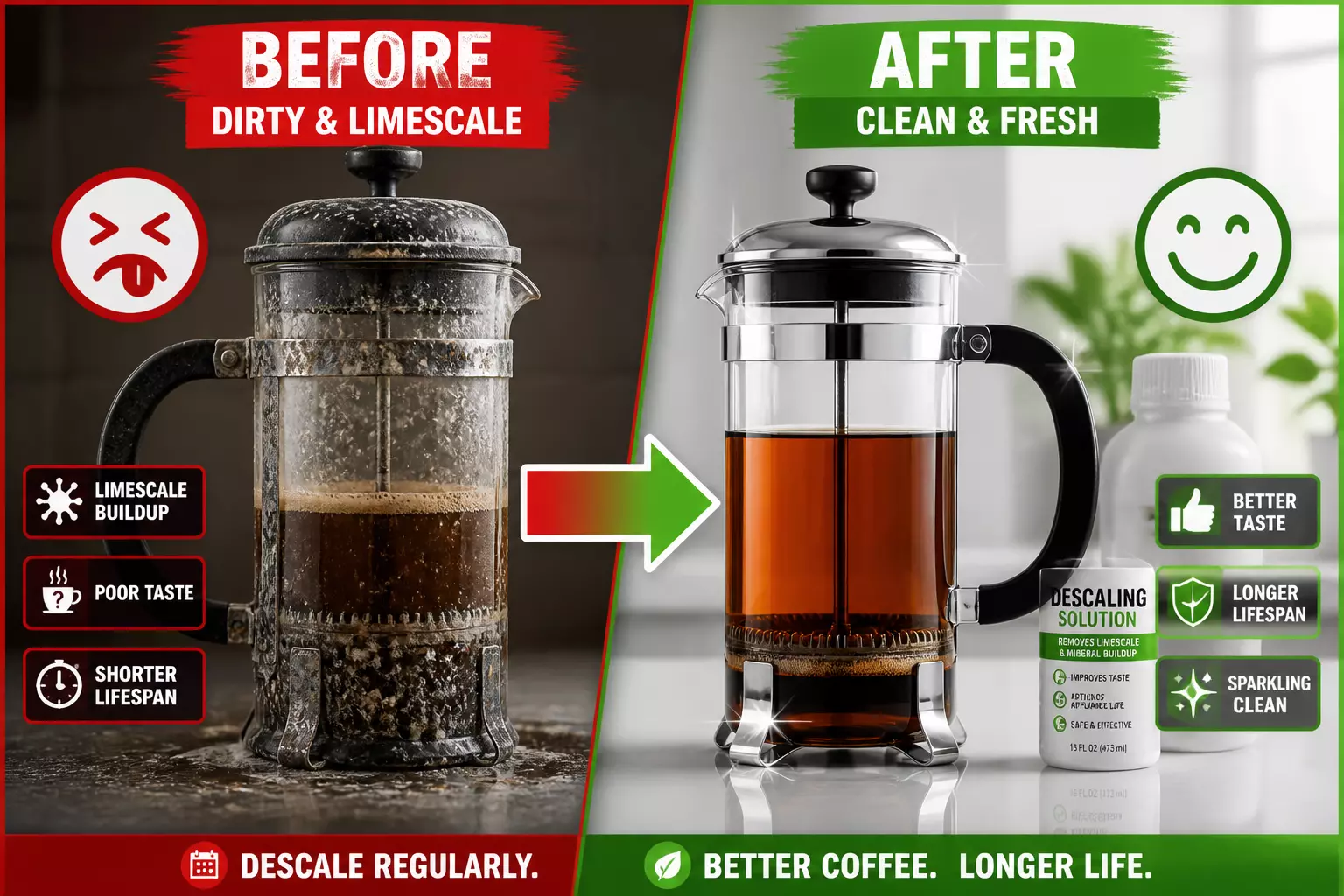
Signs Your Equipment Needs Cleaning
- ☕ Coffee tastes bitter, metallic, or “off” without obvious reason
- 🔍 White or grey crusty deposits inside your kettle or brewer
- 🐢 Slower-than-usual water flow through your dripper
- 👃 Stale or musty smell from the equipment
How to Descale and Clean
For kettles and pour-over equipment:
- Fill with equal parts white vinegar and water
- Boil or let soak for 30–60 minutes
- Rinse thoroughly with clean water (repeat 2–3 times)
- Or use a commercial descaling tablet for harder limescale
For French press:
- Disassemble fully after each use
- Wash all parts (plunger, mesh, glass) with warm soapy water
- Deep clean weekly with a baking soda paste to remove coffee oils
Cleaning frequency guide:
| Equipment | Basic Clean | Deep Clean/Descale |
|---|---|---|
| French Press | After every use | Weekly |
| V60 Dripper | After every use | Monthly |
| Kettle | Weekly rinse | Monthly descale |
| Burr Grinder | Weekly brush | Monthly disassembly |
💬 “Dirty equipment is responsible for more bad cups of coffee than bad beans. Clean your gear and you’ll be amazed at the difference.” [3]
Step 5: Store Coffee Properly and Rotate Your Supply
The Freshness Window Is Shorter Than You Think
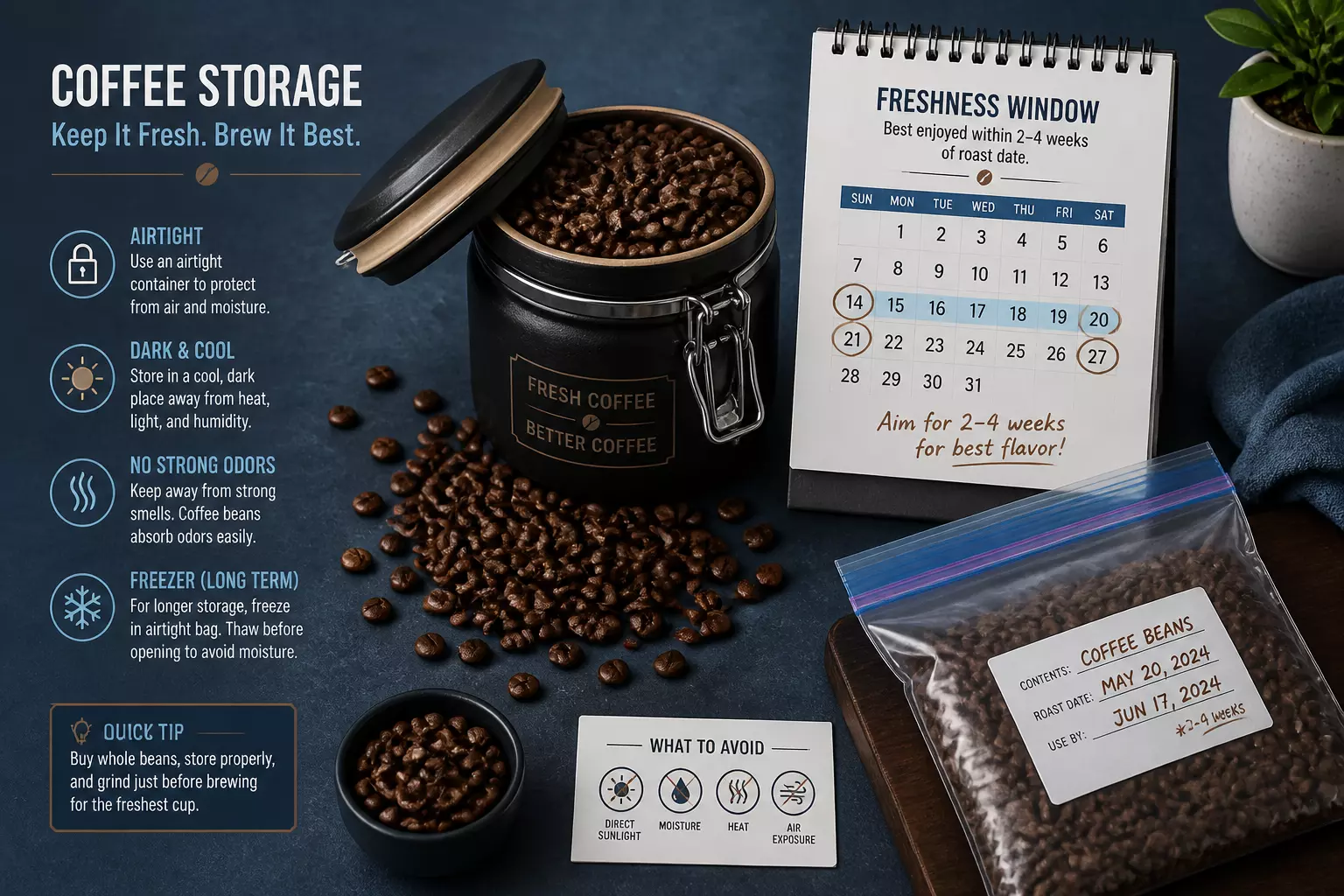
Stale coffee beans are a silent quality killer, especially for people who don’t drink coffee every day. [3] Once opened, whole beans start to oxidize and lose their aromatic compounds. Here’s what you need to know:
- Whole beans: Best within 2–4 weeks of opening
- Ground coffee: Best within 1–2 weeks of grinding
- Unopened whole beans: Good for 6–9 months from roast date if sealed
Storage Best Practices
✅ Do:
- Store in an airtight, opaque container (ceramic or dark glass is ideal)
- Keep at room temperature, away from heat and light
- Buy in smaller quantities more frequently (250g bags rather than 1kg)
- Label your container with the date you opened the bag
❌ Don’t:
- Store in the fridge (moisture causes condensation damage)
- Leave beans in the original bag once opened (most aren’t truly airtight)
- Buy in bulk unless you drink 2+ cups daily
- Store near your stove or in direct sunlight
The Freezer Exception
Freezing whole beans before opening is actually fine for long-term storage — but only if you freeze in airtight, single-serving portions and never refreeze. Thaw at room temperature before grinding. This works well if you find a great deal on fresh beans and want to stock up.
Step 6: Match Your Beans to Your Brewing Method
Why Origin and Roast Level Matter for Your Brewer
One underappreciated reason budget coffee tastes bad is a mismatch between bean origin and brewing method — not the beans themselves. [5]
Here’s a practical matching guide:
| Brewing Method | Best Origin | Best Roast Level | Why |
|---|---|---|---|
| French Press | Brazil, Indonesia | Medium-Dark | Bold body complements immersion brewing |
| V60 Pour-Over | Ethiopia, Kenya | Light-Medium | Bright acidity shines in clean filter brew |
| AeroPress | Colombia, Guatemala | Medium | Balanced flavor handles pressure well |
| Cold Brew | Brazil, Mexico | Medium-Dark | Low acidity suits long steep time |
If your coffee tastes bitter or burnt, it’s often because you’re using a dark roast with a high-extraction method like pour-over. Try a lighter roast, or switch to French press for those darker beans. [5]
Bonus: Does Instant Coffee Count as Budget Coffee?
When Instant Is Actually Acceptable
A Wirecutter/New York Times expert panel tested 12 instant coffee brands to see whether premium options genuinely outperform budget alternatives. [4] The verdict? Quality varies enormously — and some premium instant coffees (particularly freeze-dried single-origin varieties) can genuinely hold their own in a pinch.
If convenience is your priority:
- Choose freeze-dried over spray-dried instant
- Look for single-origin instant options (increasingly available in 2026)
- Use just-off-the-boil water (not fully boiling) for better flavor
- Avoid stirring too vigorously — gentle folding preserves more aroma
That said, for daily home use, a French press with fresh whole beans will always outperform even the best instant coffee at a similar or lower cost per cup.
Supermarket Coffee: What to Look For and What to Avoid
Quick Shopping Checklist 🛒
Use this checklist every time you buy coffee at the supermarket:
- [ ] Whole beans (not pre-ground)
- [ ] 100% Arabica on the label
- [ ] Light or medium roast (avoid “extra dark” or “espresso roast” unless you know your method suits it)
- [ ] Roast date printed (or calculate from best-before)
- [ ] Roasted within the last 6–8 weeks
- [ ] One-way degassing valve on the bag
- [ ] Country of origin listed (transparency signal)
Brands to Approach With Caution
Without naming specific brands (availability varies by region), be skeptical of:
- Bags with no roast date at all
- Blends that don’t specify Arabica percentage
- “Value” ranges that are significantly cheaper than everything else on the shelf
- Anything labeled “coffee blend” without further detail
Interactive Coffee Budget Calculator
Use the tool below to calculate your real cost per cup and compare your current setup against budget alternatives:
Coffee Budget Calculator
See what your daily cup really costs — and how much you could save.
⚙️ Your Current Setup
📊 Your Results
Conclusion: Your Action Plan for Better Budget Coffee
Learning how to buy great coffee on a budget (without tasting like dirt) doesn’t require expensive equipment, a barista course, or a specialty roaster subscription. It requires a few smart, consistent habits.
Here’s your immediate action plan:
- ✅ This week: Check the roast date on your current coffee. If it’s older than 8 weeks, buy a fresh 250g bag of whole-bean Arabica.
- ✅ This weekend: Pick up a French press or V60 if you don’t already own one. Budget £7–15.
- ✅ Today: Descale your kettle and clean your brewing equipment thoroughly.
- ✅ Next shop: Use the supermarket checklist above — whole beans, 100% Arabica, light or medium roast, roast date visible.
- ✅ Ongoing: Buy in 250g quantities, store in an airtight container, and rotate your supply every 3–4 weeks.
The difference between dirt-tasting coffee and a genuinely enjoyable cup is rarely about spending more money. It’s about spending it smarter. Fresh beans, clean equipment, and the right brewing method will transform your morning ritual — and keep more money in your pocket every single day.
References
[1] Watch – https://www.youtube.com/watch?v=uOFa9OvBrOk
[2] Watch – https://www.youtube.com/watch?v=xR4wtbhD7-M
[3] Coffee Tastes Like Dirt Solutions – https://cornercoffeestore.com/coffee-tastes-like-dirt-solutions/
[4] Watch – https://www.youtube.com/watch?v=r82ZolIuUGo
[5] Watch – https://www.youtube.com/watch?v=W4TUMNCcSFU
[6] Best Coffee For People Who Dont Like Coffee – https://www.lakecitycoffee.com/best-coffee-for-people-who-dont-like-coffee/